One Racket, No Catalogue: The Philosophy Behind Padelsmith
Most racket brands compete by growing their range — a new shape here, a softer core there, a fresh colourway every season. Padelsmith does the opposite. The British brand makes exactly one racket, by hand, in Almería, Spain. We sat down with founder Souhaib Benmaou to understand why — and why, for Padelsmith, that limitation is the entire point.

Inside the Padelsmith workshop in Almería, Andalucía.
A racket built to outlast its own hype cycle
Ask most founders why they started a padel brand and you’ll get some version of “I saw a gap in the market.” Benmaou’s answer is more specific, and more personal. He wanted a racket that did two things properly — things he felt the rest of the market had quietly given up on.
The first was durability. “Most rackets are made cheaply and at scale, and start losing their balance and power within a few months,” he says. His answer was to reverse the equation entirely: use the best materials available, build each racket by hand, and accept the cost and time that comes with it. The payoff, he argues, is a racket that “plays the same in its second season as it did on day one, whether you have played once or for twenty years.”
The second was restraint. Where much of the padel market has leaned into bulky silhouettes, oversized branding and loud colourways, Padelsmith went the other way. “I wanted the opposite: elegant, timeless, understated enough that the quality is the thing you notice,” Benmaou says — a design philosophy that shows up immediately in the racket’s black finish and near-absence of visible branding.
“Use the best materials you can find and make each one by hand, and you get a racket that plays the same in its second season as it did on day one — whether you have played once or for twenty years.”
Souhaib Benmaou, founder, PadelsmithWhy one racket, not a range
The most unusual thing about Padelsmith isn’t the price or the leather grip — it’s the catalogue. There isn’t one. Just the #1, in one shape, one spec, one philosophy. For a market where brands routinely run five or six models in parallel, it’s a deliberate, almost contrarian choice.
“Fewer better is the whole idea,” Benmaou explains. “One racket done properly beats a range that just makes people compare specs instead of picking one and playing.” It’s also, he admits, a matter of where the effort goes: “Every hour that would go into managing a catalogue goes into the racket itself instead.” Rather than splitting attention across a portfolio, everything — materials, testing, finishing — funnels into a single product.
It’s a bet that runs against the grain of how most sporting goods brands scale, where a wider range usually means more shelf space, more price points, and more chances to catch a buyer’s eye. Padelsmith is betting instead that one racket, made properly, is a stronger pitch than five made adequately.
The craft behind the claim
“Handmade” is a word that gets used loosely in sports equipment marketing, so it’s worth asking what it actually means on the workshop floor. For Padelsmith, it starts with construction: rather than a pressed carbon sheet — the standard, faster method used by most mass-market rackets — the #1 uses a dual tubular carbon and Kevlar build. The leather grip is conditioned and fitted by hand, not machine-wrapped.
The detail that seems to surprise people most, according to Benmaou, is what happens at the very end of the process. “Every racket is weighed and checked before it leaves the workshop rather than trusted to a spec sheet,” he says — a manual quality-control step that most buyers assume is automated at this price point, and often is, elsewhere.
That manual approach becomes harder to hold onto as demand grows, not easier — and Benmaou is candid about it being the operation’s biggest ongoing challenge. “Staying consistent as the numbers go up” is, in his words, the real test. “Every racket is still finished and checked individually, nothing gets waved through on a spec sheet, and the discipline is not letting volume push you toward shortcuts a customer would eventually feel.”
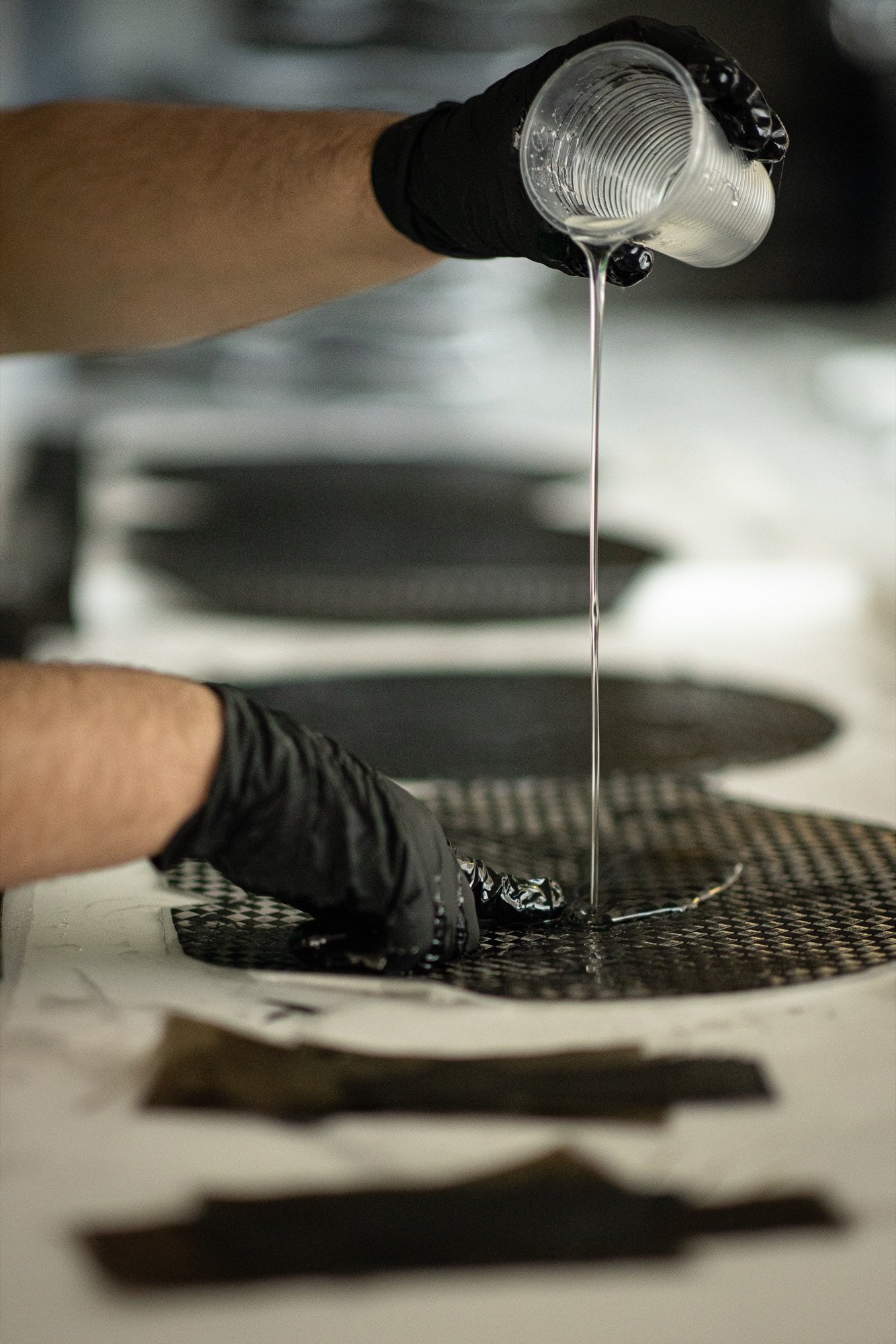
Resin applied by hand over the carbon fibre layers during construction.
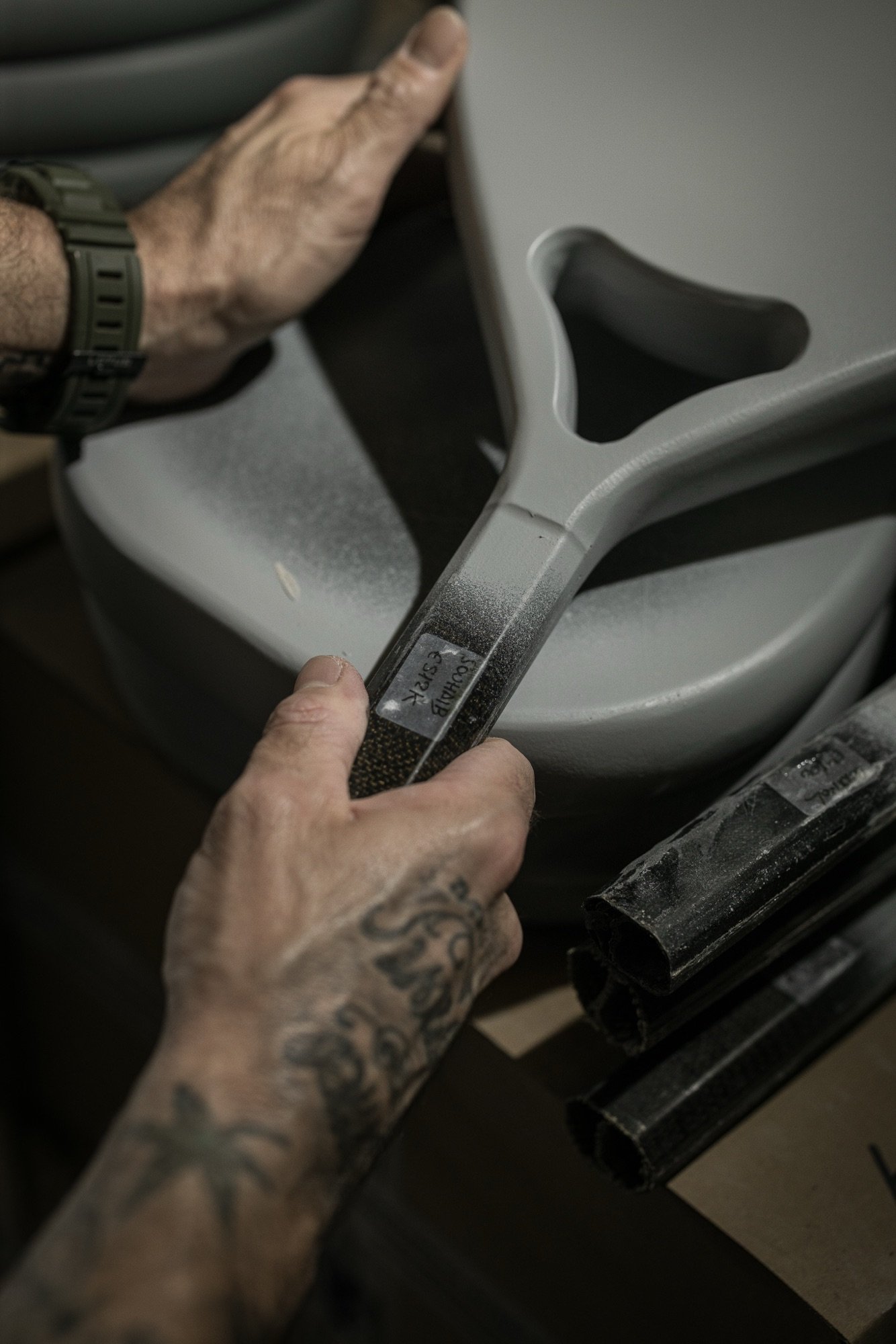
Every racket carries a handwritten reference during finishing — checked individually before it leaves the workshop.
A personalisation service that grew by accident
One of Padelsmith’s more distinctive touches wasn’t part of the original plan. Customers can have their name or initials embroidered onto the wrist strap, and the frame itself can be personalised too — a detail most players don’t know exists, and one the brand deliberately doesn’t push hard in its marketing.
“It actually grew out of customer requests,” Benmaou says. “People started asking whether initials or a name could go on the wrist strap, and it fit naturally with everything already being made by hand, so we built it out properly rather than leaving it as a one-off favour.” It’s a small example of how a handmade production model creates room for requests that a mass-manufacturing line simply couldn’t accommodate.
Competing against brands with no catalogue limit
It’s a genuinely difficult position to compete from. Mass-produced brands can out-market, out-distribute and out-discount a one-product, handmade operation without much effort. Benmaou doesn’t pretend otherwise — but he also doesn’t see it as purely a disadvantage.
“Mass produced brands win on range and marketing spend, and there is no competing there,” he says. “What we can do is make one racket well enough that people who care about feel and longevity choose it over a catalogue.” It’s a strategy built around conversion at the point of contact — the racket has to do the convincing that a marketing budget can’t.
“One racket done properly beats a range that just makes people compare specs instead of picking one and playing.”
Souhaib Benmaou, founder, PadelsmithWhat he’d do differently
Asked what he’d change if he were starting again, Benmaou doesn’t point to the product itself — he points to capacity planning. “Build in more headroom on production earlier than I did,” he says. “Demand outpacing a small handcrafted operation is a good problem, but I would plan the capacity curve sooner next time rather than solving it as it happens.”
It’s a telling answer. For a brand built entirely around doing less, better, the biggest lesson so far hasn’t been about the racket — it’s been about staying ahead of its own success without compromising the thing that makes it worth buying in the first place.
Keep exploring
This feature accompanies our full hands-on review of the Padelsmith #1 — including our own measured specs, on-court performance across attack and defence, and where it sits against other diamond rackets in its price range. Our video review is on the way; until then, follow us on Instagram for behind-the-scenes looks at the testing.