Wilson Bela Pro V3 2025 — Review
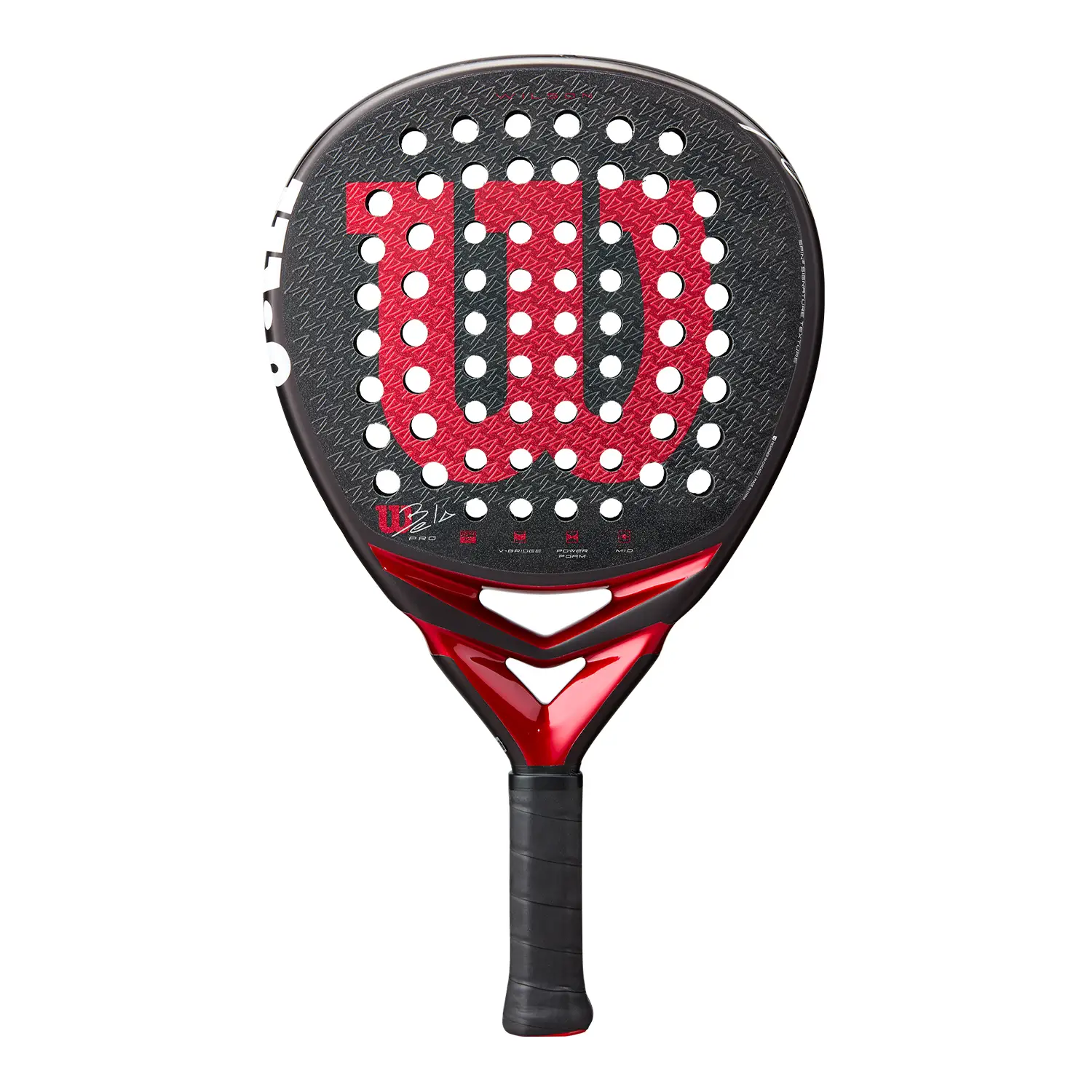
The Wilson Bela Pro V3 2025 is the flagship signature racket of Fernando Belasteguín — arguably the most decorated player in padel history. A diamond-shaped power racket built for advanced players who want a direct, no-compromise weapon for finishing points from the attacking zone.
Wilson’s padel range has a smaller footprint in the Iberian market than the Spanish and French giants, but the Bela line has a loyal following among players who value Belasteguín’s legacy and a racket built around decades of competitive refinement rather than seasonal marketing cycles.
Verdict
The Bela Pro V3 2025 continues Wilson’s tradition of building straightforward, technically solid diamond rackets without chasing the gadget-driven trends — adjustable weight systems, multi-density cores — that define most 2025–2026 flagships from other brands. What you get instead is a racket tuned purely around overhead performance: a high balance, a stiff carbon face and a core designed to convert arm speed into ball speed as directly as possible.
This directness is both the Bela Pro V3’s strength and its limitation. Players who want a no-nonsense power diamond and don’t need adjustable systems or app-connected features will appreciate its simplicity and reliability. Players looking for the latest tunable technology from NOX, Adidas or StarVie will find the V3 comparatively old-school — in the literal sense that it doesn’t try to be anything other than a well-built power racket.
PadelCritic Scores (0–10)
Pros & Cons
Pros
- Strong, direct overhead power — a genuine finishing weapon.
- Excellent build quality and durability — Wilson’s manufacturing standards are consistently high.
- Simple, no-frills design — nothing to maintain, adjust or learn beyond the racket itself.
- Belasteguín pedigree — built around decades of professional refinement.
- Solid value relative to mainstream flagship pricing.
Cons
- No adjustable weight or balance system, unlike most 2025–2026 rivals.
- Less arm-friendly than diamonds with dedicated vibration tech (Auxetic, Vibrabsorb², Ease Vibe).
- Smaller sweet spot demands consistent technique.
- Less mainstream availability than Adidas, HEAD, Bullpadel or NOX in some markets.
On-court performance
Overheads
Where the Bela Pro V3 does its best work. The diamond shape and high balance generate strong, direct overhead force — smashes are penetrating and viboras carry decent pace. The racket doesn’t add gimmicks to the process; it simply converts a technically correct swing into a fast, flat ball with minimal fuss. For players who already have consistent smash mechanics, this directness is exactly what’s needed.
At the net
Functional but unremarkable. The high balance asks for more wrist strength on reactive volleys than a teardrop or round racket would, and the stiff frame doesn’t offer much tactile feedback on touch shots. Decisive volleys carry real force, but finesse shots — drop shots, soft angles — require more deliberate technique than they would on a softer-core racket.
From the back
The most demanding aspect of the racket. The smaller sweet spot and stiff faces punish mistimed groundstrokes more than a modern dual-density core would. Defensive lobs require precise contact to maintain depth. This is not a racket built to bail you out when you’re scrambling — it rewards proactive, well-positioned play.
Comfort & vibration
The Bela Pro V3’s clearest weakness relative to 2025–2026 flagships. Without dedicated vibration-damping technology like Auxetic, Vibrabsorb² or Ease Vibe, impact shock transmits more directly to the arm. Players with elbow or wrist sensitivity should approach with caution, particularly at high weekly volumes. This is a racket for players with healthy, conditioned arms who prioritise raw performance over cushioning.
Spin
Solid. The carbon face generates reasonable topspin on drives and decent slice on defensive shots, though it doesn’t match the rough 3D textures found on rackets like the Coello Pro or Hack 04. Spin production is competent rather than exceptional.
Who is it for / not for
Good choice if…
- You are an advanced or competitive player with consistent smash mechanics.
- You want a straightforward power diamond without adjustable systems to manage.
- You have healthy arms and no history of elbow or wrist sensitivity.
- You value Wilson’s heritage and Belasteguín’s legacy as a brand.
- You play 2–3 sessions per week without heavy cumulative arm strain.
Avoid if…
- You want an adjustable weight or balance system to fine-tune your setup.
- You have a history of elbow or wrist pain — choose a racket with dedicated vibration tech instead.
- You are intermediate or still developing your overhead technique.
- You play left side and prioritise control over power.
Specifications
| Shape | Diamond |
|---|---|
| Weight | 360–375 g |
| Balance | High |
| Faces | Carbon fiber |
| Core | EVA (firm) |
| Level | Advanced / Competitive |
| Signature | Fernando Belasteguín |
Note: some technical specifications (exact weight range, balance point in mm, and core hardness classification) are based on the general Bela Pro line positioning and should be confirmed against the official product listing before publishing if precision is required.
Alternatives
| HEAD Coello Pro 2026 | More powerful, Auxetic 2.0 comfort technology | More expensive, smaller availability gap |
| Bullpadel Hack 04 2026 | Custom Weight system, Ease Vibe comfort | Higher price, different brand positioning |
| Babolat Viper JL 3.0 2026 | Excellent Vibrabsorb² comfort, more arm-friendly | More expensive, different core feel |
| Adidas Metalbone HRD+ 2026 | Adjustable Weight & Balance system | Higher price, different brand ecosystem |
In 30 seconds
- Fernando Belasteguín’s signature power diamond — straightforward and direct.
- No adjustable weight system — simpler than most 2025–2026 rivals.
- Strong overhead power, but less arm comfort than rackets with dedicated vibration tech.
- Best for advanced players with healthy arms and consistent smash mechanics.
- Want more comfort at a similar power level? Consider the Babolat Viper JL 3.0 2026.